
You might feel like tarring and feathering me for saying that, but please hear me out.
The more I learn about organic farming practices, the more I find that USDA Certified Organic does not mean what many people think it means. I have also found that it is not necessary to double your grocery bill with only organic products to reduce your consumption of pesticide residue overall and to support more sustainable farming.
In my quest to lead a more healthy lifestyle, I have plummeted into a few common pitfalls. I'm sharing what I have found in hopes it helps you on your journey and you can skip some of the pitfalls I have fallen into.
Learning is a process, folks, so expect me to form an opinion, to learn more, and then to change my mind.
Use the Environmental Working Group's Dirty Dozen and Clean 15 lists with caution and context.
When it comes to moving towards getting the chemicals/pesticides our of your diet, the Environmental Working Group has created the popular dirty dozen and clean 15 lists that look at fruits and vegetables with the highest and lowest pesticide load to support this effort.

Most people (myself formerly included) look at the list and immediately assume that buying organic is the way to get pesticides out of their diet in these foods, right? Wrong.
I'm always a little surprised by how many folks don't realize that organic farmers use pesticides too. They use some synthetic pesticides in restricted amounts and some natural pesticides, but just because something is natural does not inherently make it better for consumption.
Check out this list of pesticides approved for use in organic farming straight from the US Government Publishing Office. (Yay for primary sources!).
While I think that EWG's intentions are good, their methodology leaves much to be desired: EWG's lists are not considering the environmental impact of the pesticides or the level of toxicity of each pesticide when consumed.
Sure some fruit may have residue from a particular pesticide, but it may be one that isn't as toxic as another pesticide found in smaller amounts in a different kind of produce. The way the list is constructed, the smaller amount of the more toxic pesticide still puts the produce in question lower down/off the dirty list and the produce with the greater, but less toxic, pesticide further up on the dirty list. It should be more nuanced than that.
Plus, there is no consideration given to what the chemical does to bees and birds and other wildlife. Organic farmers can use copper sulfate, for example, which can be highly toxic to fish and moderately toxic to birds (the bees seem okay though, so yay for that!). Check out the facts on copper sulfate here
One of the simplest ways to not kill your budget with organic produce, but still get high quality product is to buy in bulk and buy direct from the farmer when fruits/veggies are in season.
A grower will know if what they are selling would pack and go to market as certified organic. They know what they sprayed with and what kind of pest management system they are using. All you have to do is ask and they will tell you. When you buy in bulk, you can preserve the fruit yourself for consumption during the rest of the year (thus also skipping less-healthy preservation options).
By asking questions and buying local and direct, you have done the earth a favor. You skipped cross-country or even international shipping. Bulk fruit purchased directly is rarely packaged in small bags or plastic clams. Also, home canning jars are used year over year instead of heading to the trash or recycle bin. The money went directly to the farmer, which is great for them. It's a winning situation all around.
Don't know where to find the farmers? Start on craigslist and try local farmers markets. Once you establish a relationship, you can go back to the same sources over and over for great product. I have an apricot and cherry guy, a blackberry guy, a raspberry lady etc. A few quick phone calls and I can be swimming in high-quality, sustainably farmed produce.
Familiarize yourself with the farming practices of your family's favorite kinds of produce.
Every family has their favorites. We eat lots of apples, peaches, and blueberries. I know more about production of these fruits than say, plums, which we don't really eat that often. Apples appear on top of the dirty dozen list, but many non-organic producers use great, sustainable pest management systems to avoid needing to use so many/large amounts of pesticides.
Are they certified organic? No.
Are they responsible and doing good things to not pollute the environment and disrupt the surrounding ecosystem? Yes.
Is there less pesticide residue in/on their fruit as a result? Yes.
This goes back to my second point... buy direct and talk to the farmer. They know what's on their fruit. Over time, with some research here and there, you will learn what pesticides are worth walking away from and which growers to go to in an effort to avoid them.
Grow what you can yourself.
What you can grow will vary by year and your life at the moment. In past years, I have had large gardens, but this year (because of clean up needed on our new property to create good garden space and the arrival of a new baby in the spring) all I could muster was a container garden.

.
But it is always worth trying to do something. Every tomato or head of lettuce you grow is one less item that is mass-farmed, packaged, and shipped to your local grocery store.
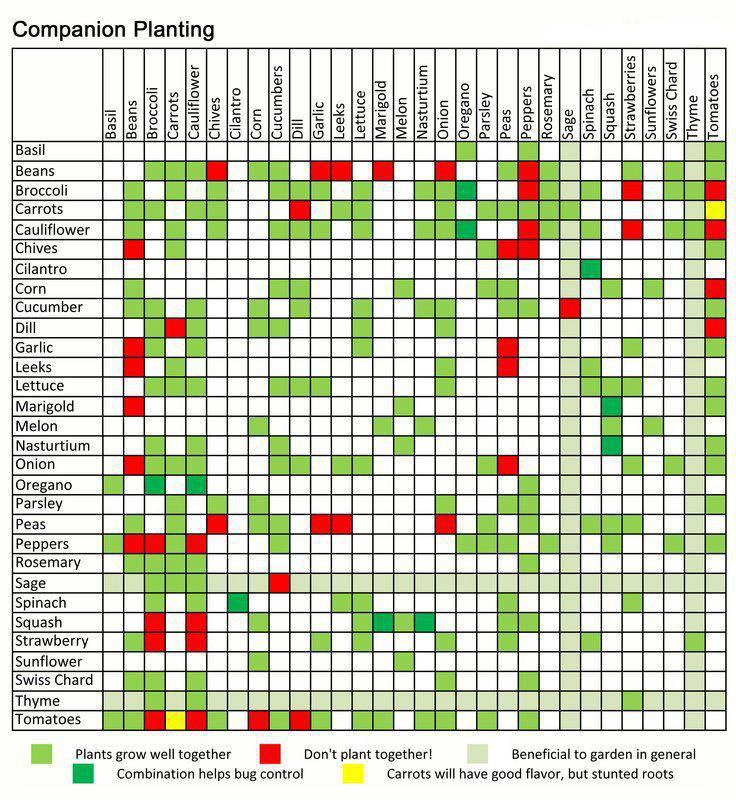
Plus, you can probably get away with using very few or no pesticides when growing produce in your backyard and using companion planting. Here's a handy chart to assist:
I hope you don't want to run me out of the blog-o-sphere now. I appreciate the USDA's effort to encourage better farming practices, but I don't think certified organic produce is the one size fits all silver bullet.
Sometime I'll talk about meat production and the labeling... mass meat production is gross and interesting.

No comments:
Post a Comment